
Landscape and Urban Planning, 266 · 2026
From Vulnerability to Adaptation: A Review of Global Evidence
A systematic review and meta-analysis explaining when adaptation reduces the economic vulnerability of land and property—and when it does not.
View published paper
The story
Climate risk is written into the value of land
Floods, hurricanes, wildfires, heatwaves, and other hazards do more than damage buildings. They alter how households understand risk, how insurers price exposure, and how markets value entire neighborhoods. These effects are uneven: the same event can become a temporary disruption in one place and a lasting economic setback in another.
Adaptation is intended to change that trajectory. Yet the term covers very different actions - from seawalls and restored wetlands to insurance, zoning, structural retrofits, and community programs. This review asks a practical question: across this wide policy landscape, when does adaptation protect land-based economic value, and when can it create new vulnerabilities?
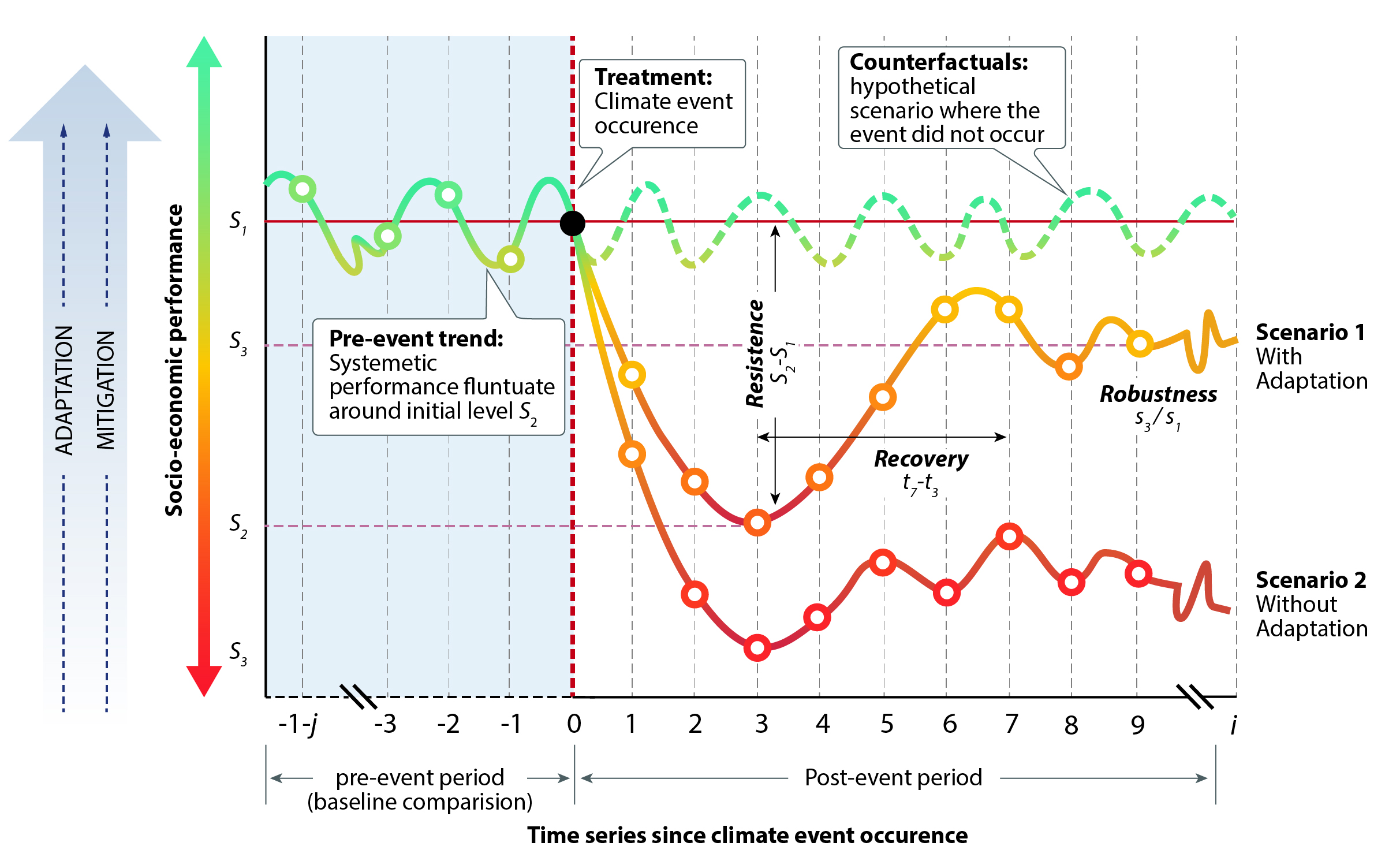
A dynamic view of resilience
Recovery is a path, not a single before-and-after result
The study treats resilience as an economic trajectory after a climate event. Adapted and unadapted places may experience similar initial shocks, yet diverge in the depth of loss, speed of recovery, and level at which values eventually stabilize.
That distinction matters because a policy can reduce immediate damage without restoring long-run value, or raise property values while shifting risk elsewhere. Measuring resistance, recovery, and robustness together makes those trade-offs visible.
Research design
Approach
- A PRISMA-guided systematic review of 108 original studies.
- Bibliometric synthesis of hazards, geographies, methods, and land-market outcomes.
- Random-effects meta-analysis of 44 quasi-experimental property-value estimates.
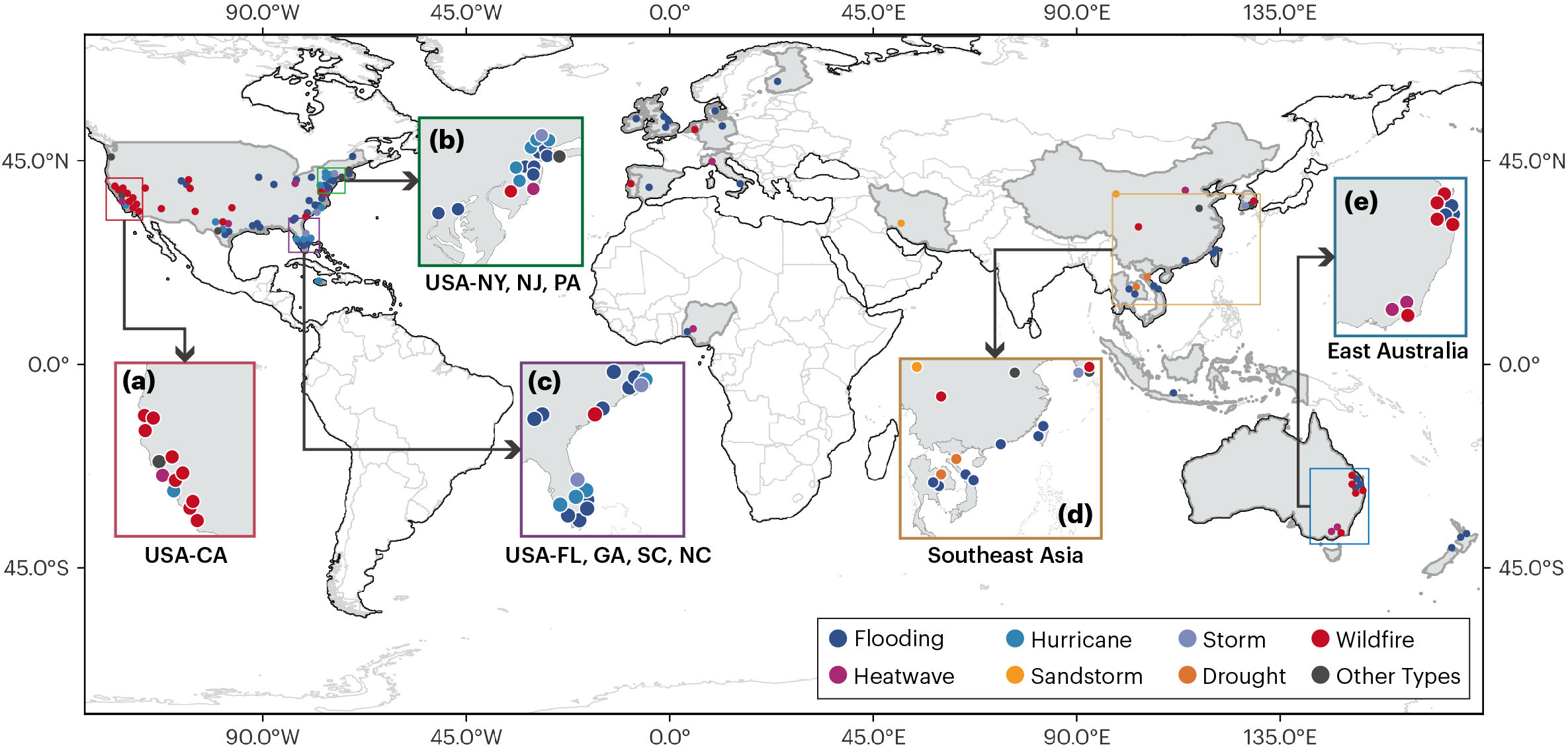
Where the evidence comes from
A global question supported by an uneven map of cases
The review assembles empirical cases across multiple hazards and regions, but the map exposes a strong geographic imbalance. The United States dominates the literature, while Africa, Latin America, smaller island nations, and many rapidly urbanizing regions remain sparsely studied.
Those gaps limit how confidently current findings can travel. Institutions, land tenure, insurance systems, planning capacity, and informal development all shape how risk is capitalized. Expanding evidence beyond high-income housing markets is therefore part of the adaptation agenda itself.
How the evidence is distributed
Bibliometric analysis
- The evidence base is growing rapidly: nearly half of the 108 reviewed studies were published after 2020.
- Property and parcel values dominate the measured outcomes, while flooding and wildfire receive the most attention.
- Panel and pre-post designs are expanding, but the literature remains concentrated in the United States and residential property.
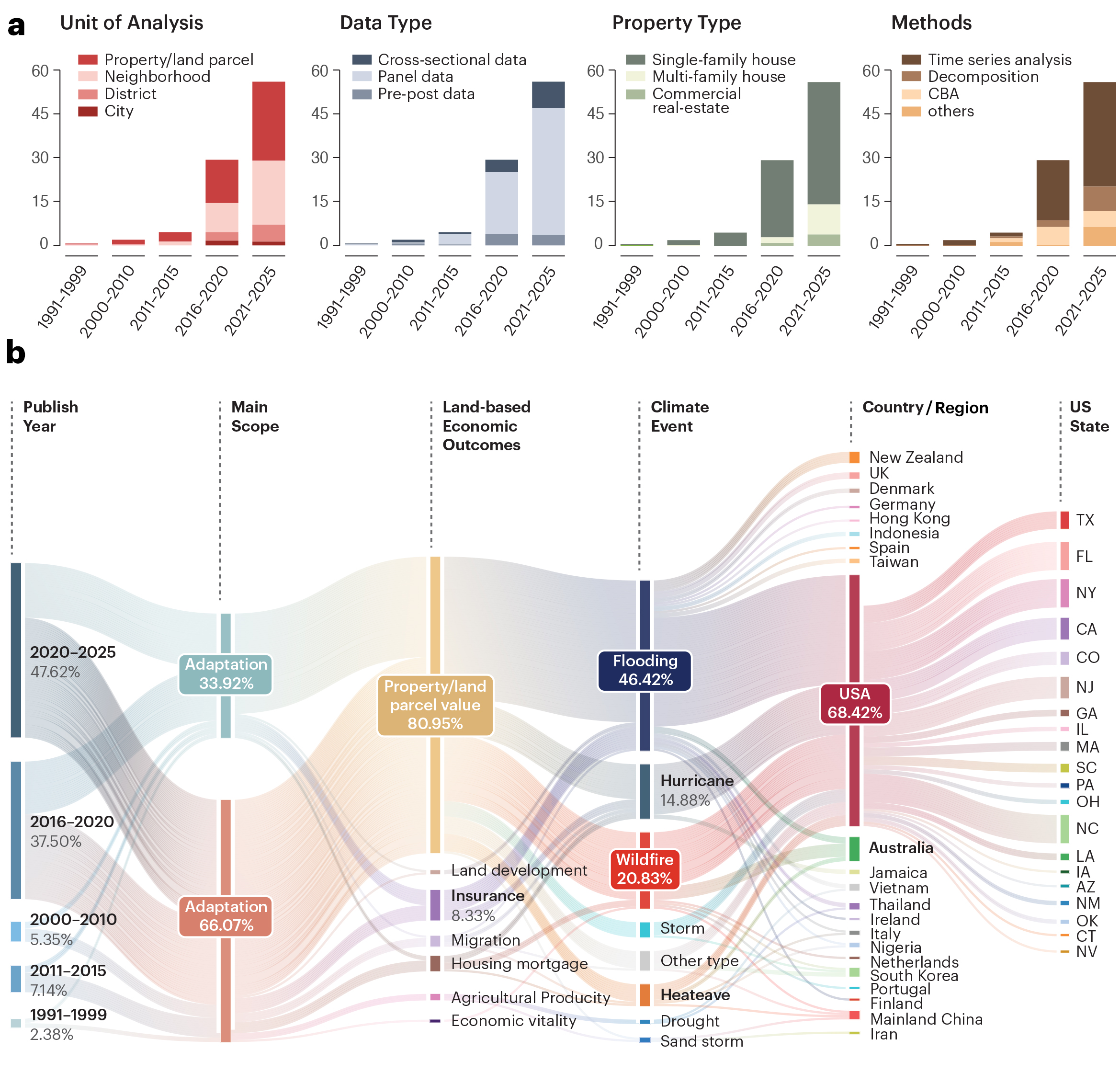
The evidence landscape
Research is growing quickly, but remains concentrated
The systematic review includes 108 original studies. Nearly half were published after 2020, and the field has increasingly adopted panel data and quasi-experimental methods. Property and parcel values remain the dominant outcome, while flooding and wildfire receive the most attention.
For the quantitative synthesis, 44 treatment-effect estimates trace how adaptation changes property-value vulnerability. This focus provides a comparable economic signal, but it also reveals what is missing: commercial property, multifamily housing, informal settlements, cascading hazards, and longer neighborhood transitions.
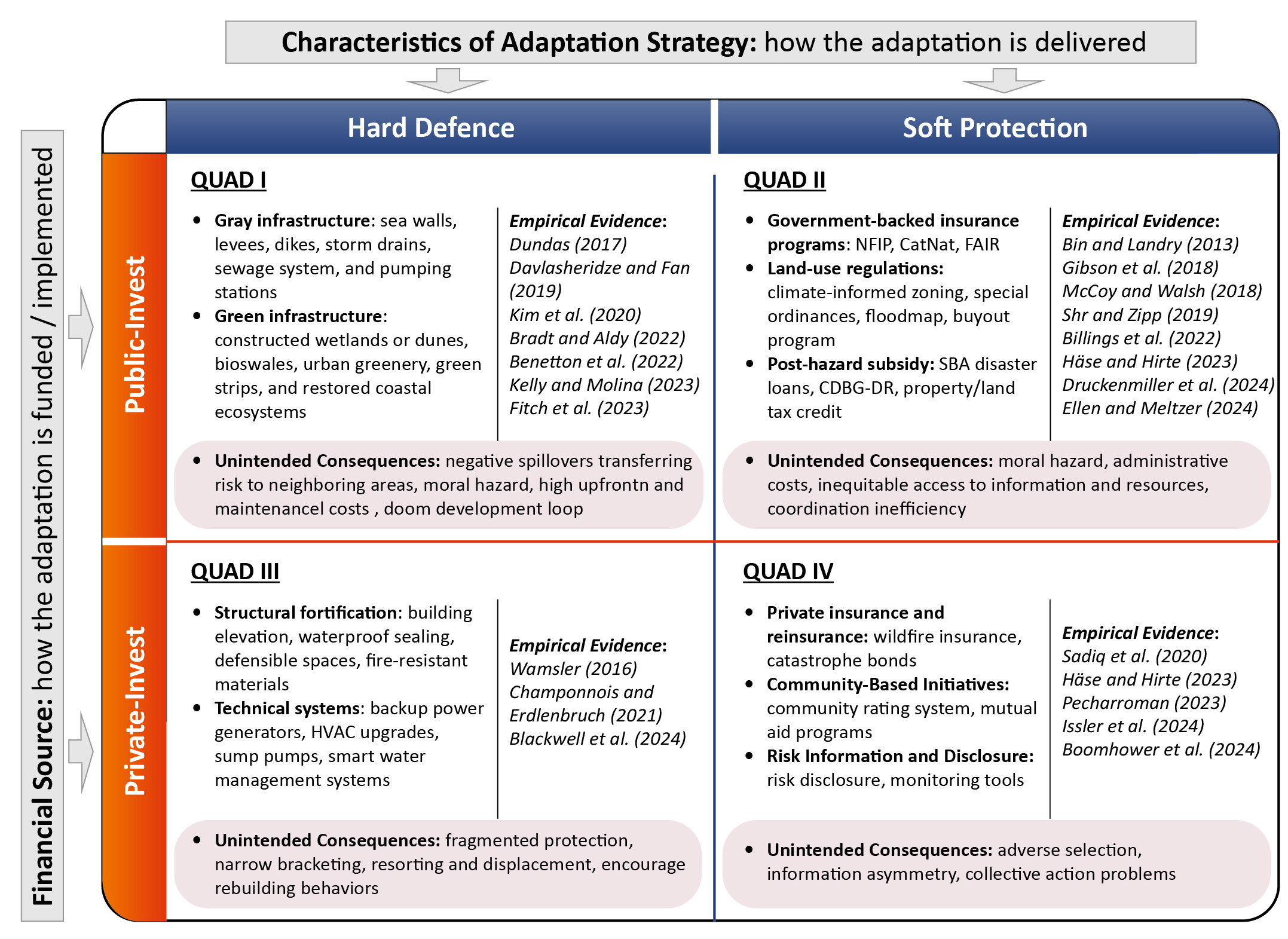
The policy lesson
No singlemeasure isresilience
Across the meta-analysis, adaptation reduces the property-value impact of climate hazards by 7.7 percentage points on average. But the average conceals opposing outcomes: some interventions transfer risk, encourage development in hazardous areas, create moral hazard, or distribute protection inequitably.
The policy matrix therefore pairs hard and soft protection with public and private investment. The central lesson is coordination. Physical defenses, regulation, insurance, information, and community capacity must work as a portfolio, with indirect effects and equity considered from the beginning.